
Rooted in two decades of building trust: Unity Health’s new Indigenous Health Research Stream
A new research stream dedicated to supporting a vibrant, connected community of Indigenous researchers has launched at Unity Health Toronto.
The initiative, called the Indigenous Health Research Stream, is founded on the knowledge that research led by and accountable to Indigenous communities can help rebuild trust and reshape how care is delivered.
It is co-led by Dr. Mikaela D. Gabriel (Mi’kmaq) and Dr. Janet Smylie (Metis), who both hold Canada Research Chairs. The stream is rooted in Indigenous values and principles and grounded in the firm belief that this work deserves to be uplifted, resourced, and reflected across every health discipline.
The aim of the research stream is to build a thriving and networked community of Indigenous health researchers across all research pillars at Unity Health Toronto that is:
Transforming Indigenous clinical care and, in turn, improving health outcomes;
Partnering with Indigenous community service providers and leaders to advance health;
Grounded in Indigenous worldviews and lived Indigenous realities;
Demonstrating interventions that are tangibly interrupting anti-Indigenous racism in health services and beyond;
Addressing gaps in Indigenous health information through the Indigenous stream of Vital, a national health data platform led by St. Michael’s physicians Amol Verma and Fahad Razak. This Indigenous stream of Vital is co-led by Dr. Janet Smylie.
Why this work is urgent
First Nations, Inuit and Métis peoples in Canada face striking and cross-cutting inequities, which are a direct result of colonial policies, racism, and systemic inequities. Within health research specifically, Indigenous peoples have too often been exploited and marginalized rather than centred as research leaders.
Systemic barriers play out too often in the care experiences of Indigenous peoples. Indigenous health needs are not only commonly unmet when community members seek care at hospitals and healthcare institutions, provided “care” is actually harmful, leading to fractured service relationships and distrust in care systems.
The ramifications are life-changing, and include preventable morbidity and mortality, service disengagement, and reinforced community distrust in healthcare systems that exclude Indigenous views and realities in their care delivery. For example, the Our Health Counts Toronto study, co-led by Dr. Janet Smylie and Seventh Generation Midwives Toronto, found that 28% of First Nations, Inuit, and Metis adults living in Toronto had been treated unfairly by a healthcare professional because they were Indigenous, and for 71% of that population, this interfered with their return to health services. Tragically, this data reflects national trends and calls to action in addressing anti-Indigenous racism in primary care centres and hospital networks, leading to an apology by the Canadian Medical Association.
Two decades in the making
The stream emerged through two decades of relationship building and institutional commitment:
In 2007, a pipe ceremony was held with Dr. Smylie, Elder Maria Campbell, and executive team members at St. Michael’s, who gathered to signal that St. Michael’s Hospital would be a “place of refuge” that would share resources to support Indigenous health research.
Five years later, Well Living House, an action research centre for Indigenous infants, children, and their families’ health and well-being, was officially launched with a signed memorandum of understanding across hospital leadership to co-govern with a Counsel of Indigenous Grandparents.
Today, Well Living House has expanded beyond one research centre to become a cross-cutting network of Indigenous health researchers and multiple Indigenous scientists who hope to continue to grow across all pillars.
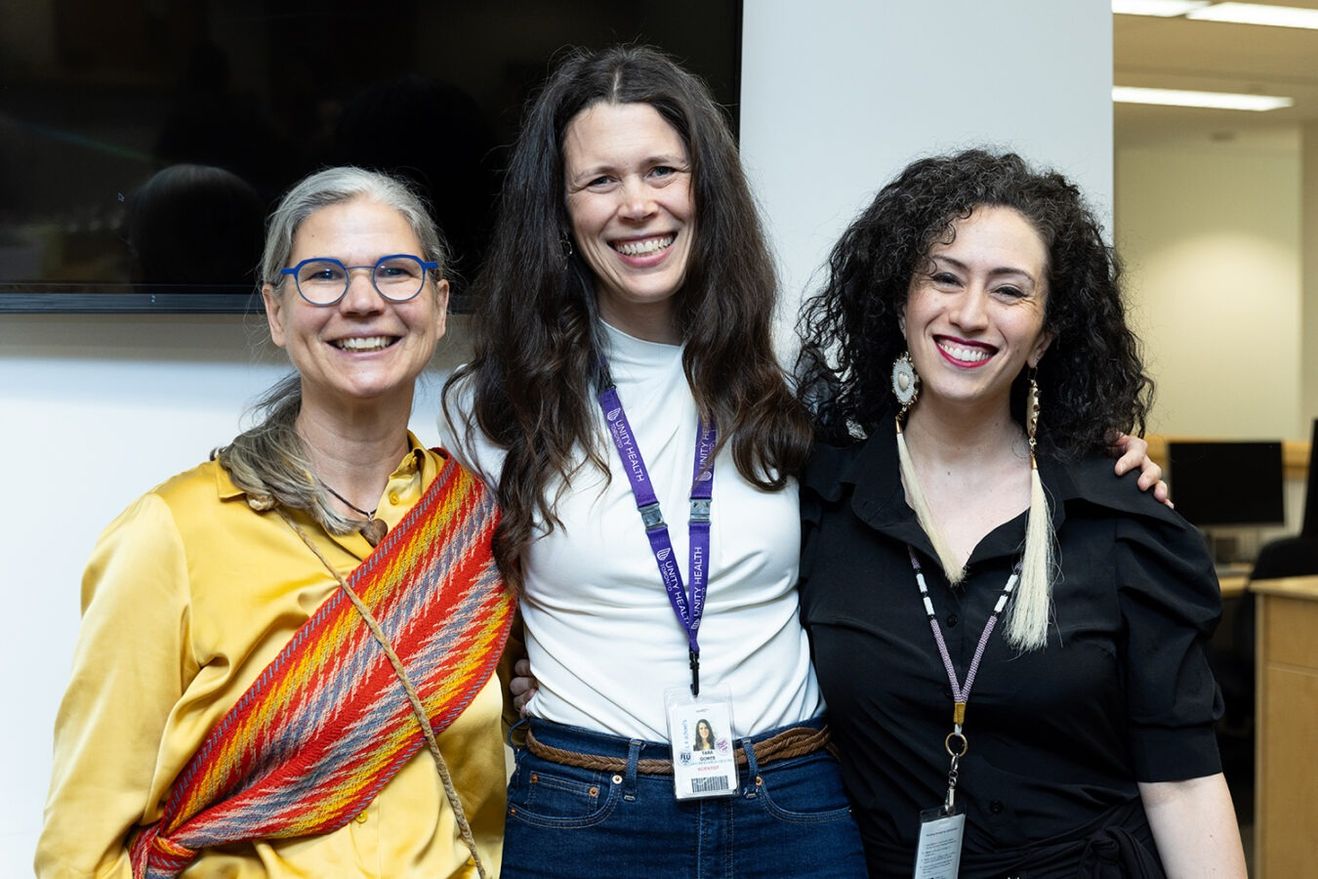
Earlier this spring, the new Indigenous Health Research Stream hosted a launch event at St. Michael’s Hospital. It brought together researchers, community partners, and staff to the space that will be dedicated to the stream’s work and collaboration.
Artist Shaun Howe unveiled a new mural, created with mural assistant Anna Jacobs, depicting Makwa (the Bear) gathering among blueberries, chokeberries and elderberries, symbolizing strength, perseverance and knowledge, while a chickadee looks on, patient and observing, teaching balance. The full moon glows above, surrounded by a constellation of stars, representing connection to the spiritual world.
Attendees at the launch event were Elder Alita Sauve, who led a pipe ceremony with Indigenous health leaders and hospital executives; Métis midwife Cheryllee Bourgeois of Seventh Generation Midwives Toronto and the Call Auntie Clinic; staff from the Waakebiness Institute for Indigenous Health at the University of Toronto; and representatives from the Ontario Network Environments for Indigenous Health Research. Celebrating the stream launch were members of the research stream’s leadership circle, including Dr. Smylie, Dr. Gabriel, Dr. Tara Gomes, Samar Saneinejad, and Dr. Andrea Tricco.
By Zehra Goawala
Originally posted to UnityNet
Share this Article


